
To celebrate California’s official state bat, we’re revisiting a 2020 interview with our own bat-specialized environmental scientist
Welcome to Bat Week!
Bat Week is an international and annual celebration to bring awareness to bat conservation – a big area of focus for the Department of Conservation. In 2024, Governor Gavin Newsom signed a bill naming the Pallid Bat as California’s official state bat.
The pallid bat is known to be as diverse as our state. Found in most areas of California, pallid bats communication and diet varies by region and community.
Around the world, bats are vital to our ecosystems, and they sometimes get a bad rap. They pollinate flowers, eat insects, and even spread seeds. Bats help with natural pest control and contribute to climate resilience.
In California, there are 25 native species of bats, and many of them live in abandoned mines.
An interview with a “bat biologist”
To bring attention to Bat Week, we spoke with Trinity Smith, an environmental scientist and wildlife biologist with Department of Conservation’s Division of Mining and Reclamation Abandoned Mine Lands Unit (AMLU). Trinity specializes in bat conservation.

Photo Credit: J. Danielson Great Basin Institute.
Department of Conservation’s role in bat conservation
Trinity is part of a specialized team of engineering geologists, environmental scientists, and geospatial professionals dedicated to inventorying California’s abandoned mines.

There are ten-of-thousands of old and abandoned mines in California, many dating back to the Gold Rush. These mines can be hazardous to public health and safety. But, they can also become valuable habitat for wildlife, including bats.
When Conservation’s mining team and partners need to keep human visitors out of an abandoned mine, they work to ensure it is still accessible to wildlife using it as a habitat.
Trinity joined the unit in December of 2019 and has been working primarily with bats for several years.

Photo Credit: J. Danielson Great Basin Institute.
Q: Hi Trinity! Could you tell us a little about yourself?
Prior to joining the Department of Conservation, I worked with all sorts of wildlife in the western United States including fish, frogs, small mammals, birds, and bats.
I first started working with bats while getting my Master’s Degree from Humboldt State University, on a project studying how they use agricultural lands in the Central Valley, especially during a drought.
Since then, I’ve conducted my own bat research in abandoned mines, and helped other biologists in all corners of California, from lava tubes to the redwoods.
Q: What made you want to work with bats?
I fell into bat research after working with small mammals like mice and shrews. Although bats are most certainly not flying mice, it felt like a natural progression. Once I learned how unique each species of bat was, I fell in love.
I always enjoyed touring caves and stargazing as a kid, so I guess it makes sense that I ended up working with wildlife that could let me continue to do those things.
I really enjoy learning and teaching people about bats because they are so commonly misunderstood. It’s great to root for the underdog.
Q: What do you do as an environmental scientist?
I partner with different landowning agencies – including Bureau of Land Management, National Park Service, National Forest Service, state agencies and non-governmental organizations – and help them find mines that are hazardous to people.
My work first starts with inventorying sites and documenting abandoned mines from the surface. This is when we determine if these sites need further inspection.
I have special training to enter abandoned mines with a partner and safety equipment.

Photo Credit: J. Danielson, Great Basin Institute.
While underground, I assess what wildlife live in these mines and what hazards may await human visitors.
If there are bats or other animals, we will recommend a remediation that balances human safety and wildlife habitat conservation. We try to get the best of both worlds.
I also get to help our partners with statewide bat survey efforts including surveying bats in caves at Lava Beds National Monument, White Nose Syndrome monitoring and captures, and bat population studies. These projects are rewarding because they bring California’s bat experts together for larger bat conservation projects.
Q: How do bats help the environment?
Well, there are over 1,400 species of bats all over the world; they are the second most abundant group of mammals.
In California, we have 25 species of bats.
All of California’s bats are insectivorous, meaning they eat bugs and kill pests on our natural and working lands. Bats help keep our ecosystems, and us, healthy.
Bats save farmers an estimated $3.7 billion in pest control services in the United States. A recent study just liked the decline of bats to a rise in newborn deaths from insecticides.

Photo Credit: J. Danielson Great Basin Institute.
Q: Why is bat habitat conservation so important?
Across the U.S., bats face many threats. Disease, wind turbines, roost destruction, climate change, and other threats have led to bat population declines.
It is important we do our part to help build awareness of the important role they play in our ecosystems and how we can help protect them.
One of the current major threats, White Nose Syndrome (WNS), is a disease that spreads in large bat colonies. It is a fungus that grows on bats’ skin and wakes them during hibernation.
WNS has killed millions of bats and is currently spreading west. We have found the fungus in four California counties but have not encountered any bats with WNS so far.
Unfortunately, it may only be a matter of time until we find bats with the disease.
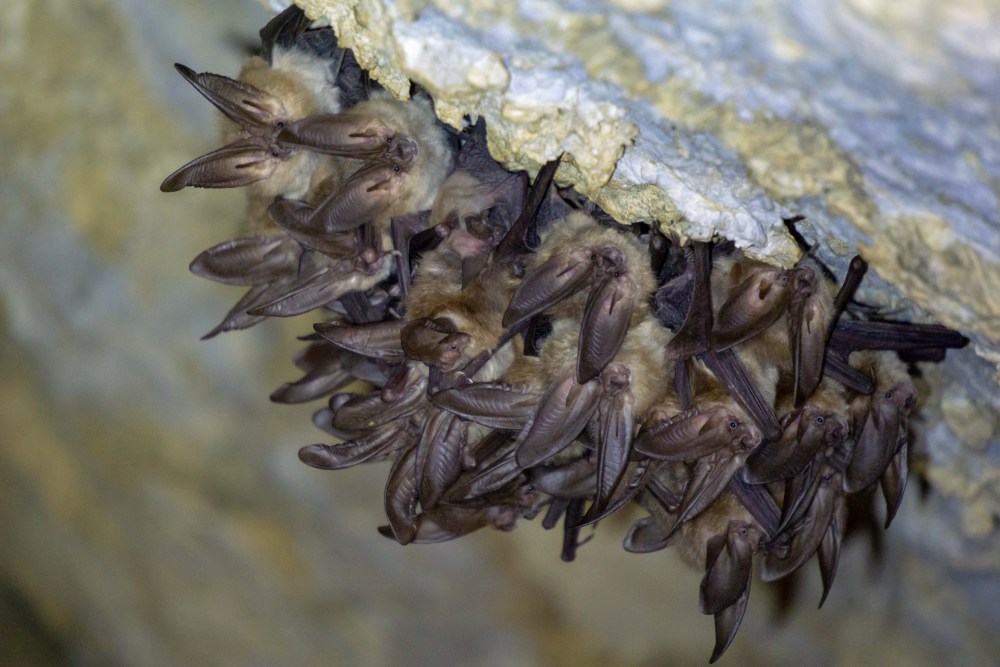
Photo Credit: J. Danielson Great Basin Institute.
Early detection of WNS depends on a coordinated effort between bat biologists and community members. If you find sick or dead bats, please report them to California Department of Fish and Wildlife.
More commonly, bats are disturbed by people exploring roost sites (like mines and caves) during critical periods of their lifecycles, often without realizing it. This exploration can pressure bats to move or abandon roost sites. This is why Conservation’s mining team’s work is so critical for protecting California’s bats.
You can help protect bats by not entering bat roosts, especially abandoned mines.
Learn more about Bat Week here.

Follow Department of Conservation’s Facebook, Twitter, and Instagram for more facts on our abandoned mine-dwelling friends.
This blog was modified in October 2024 to include the Pallid Bat being named California’s state bat.
